
What Does Better Data Governance Mean for Honolulu?
In August, we explained why Hawaiʻi Data Collaborative supports Question 15 on the November 3 ballot in the City and County of Honolulu. This post looks at what better data governance could mean in practice for residents, City staff, and community organizations.

It Starts with the Right Questions
We believe that sound data supports effective and efficient government through evidence-based decision-making. It helps answer questions like:
Are City services having their intended impacts?
Are there communities that still need additional support, and if so, what is the best way to provide support?
Is the City effectively managing resources in service of its residents?
These seemingly simple questions often require combining information from multiple offices or data sets that may have their own definitions, formats, and rules for sharing. The City’s data systems exist, but many were built to support individual programs, not to connect the dots across them or to make data easy to use for answering these questions.
Giving Data Governance a Permanent Home in Honolulu
In 2022, Honolulu created a Chief Data Officer position and two data specialist positions to address this issue. Question 15, a proposed City Charter amendment, would give this work a permanent home by establishing an Office of Data and Innovation. If approved by voters, Question 15 would charge the new Office to:
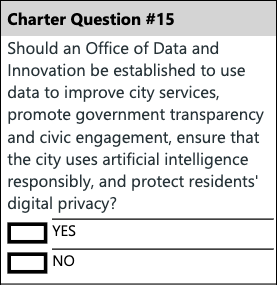
Develop a citywide data strategy and standards, including for the use of artificial intelligence (AI);
Use data and innovation to improve City services and make government more efficient;
Promote government transparency and civic engagement; and
Protect residents’ digital privacy.
The City already collects data and uses AI every day. Question 15 lets voters decide whether to make data oversight a lasting priority by establishing the responsible office in the City Charter.
Three Scenarios That Show Why Data Governance Matters
Scenario 1: A resident is trying to apply for social services
A local resident is struggling to make ends meet and is looking for government support to help with their family’s expenses: food, housing, childcare, anything that would make a difference. Today, they must research programs and apply separately to multiple agencies, each with its own documentation and eligibility requirements. Even if they are diligent, they may never know whether they have applied for everything available to them, and they may spend precious time applying for programs they do not qualify for.
With coordinated data systems and clear data-sharing standards, that resident could share their information once and be connected to the programs they are likely eligible for, with less paperwork and fewer dead ends.
Scenario 2: City offices and a nonprofit are trying to understand and address a community need
To address community need well, City offices and their nonprofit partners need an accurate picture of who is affected, where, and how much. That requires pulling data from multiple sources, reconciling different definitions, and figuring out what is appropriate to share across agencies and with nongovernmental partners.
With citywide data governance policies in place, everyone would be working from clear privacy standards and cleaner, consistently defined data sets, making sharing easier and decisions more informed and timely.
Scenario 3: A resident is concerned about their privacy in the age of AI
A resident wants to know what data the government has connected to them, and whether other residents, City employees, or AI have access to that information. Is their information safe from data leaks? Is it being used against them? Is it being fed through AI to make decisions that affect them in ways that aren’t direct, immediately obvious, or explicitly disclosed?
An Office of Data and Innovation would be responsible for setting clear rules on how resident data is collected and used, answering these questions, and fixing problems when something goes wrong.
Question 15 Is a Long-Term Investment
Creating an Office of Data and Innovation would make managing City data, protecting residents’ privacy, and guiding the responsible use of AI a permanent responsibility of City government, with the capacity to keep pace as technology evolves. It won’t solve all of Honolulu’s data challenges overnight or guarantee that mistakes will never happen, but it will give the City a lasting foundation for getting data governance right.
Imagine if residents, government employees, policymakers, and community organizations could all spend less time navigating difficult systems and worrying whether they got it right. Imagine if that energy could go toward making better decisions faster, and serving people well. These are the practical results that a “yes” vote on Question 15 has the potential to deliver.