
Act 154 and Hawaiʻi's First Look at Statewide Data Governance
Many of Hawaiʻi’s most pressing challenges, from workforce development to education and social services, span multiple agencies and systems. Addressing them effectively will require combining data from different agencies and community partners. But in practice, that kind of coordination and collaboration can be difficult due to sharing, privacy, and governance concerns.

Assessing State Data Systems
Motivated by the importance of data for addressing the “affordability crisis” in Hawai‘i, as well as the need for improved visibility into Hawaiʻi’s education to workforce pipeline, the state legislature passed Act 154 in the 2025 legislative session. This act established a Data Sharing and Governance Working Group (DSGWG) within the Office of Enterprise Technology Services. Chaired by the state’s CIO and comprised of representatives from various state agencies, and private and nonprofit sector representatives, this group is tasked with analyzing and assessing existing data sharing capacities within state government, and developing recommendations for how the state should govern data moving forward.
The Act lays out a broad mandate, while specifying education to workforce data as a testing ground of sorts for reviewing specific technical capacities, or lack thereof, to access and share data. The data sets under review include high school to workforce data, higher education data, federal employment data, self-employment data, and unemployment compensation wage records that capture occupation, pay rate, and work location, along with other data from federal, state, and county-level sources. This information is needed to develop a clear, complete understanding of Hawaiʻi’s workforce.
What the Working Group Will Recommend
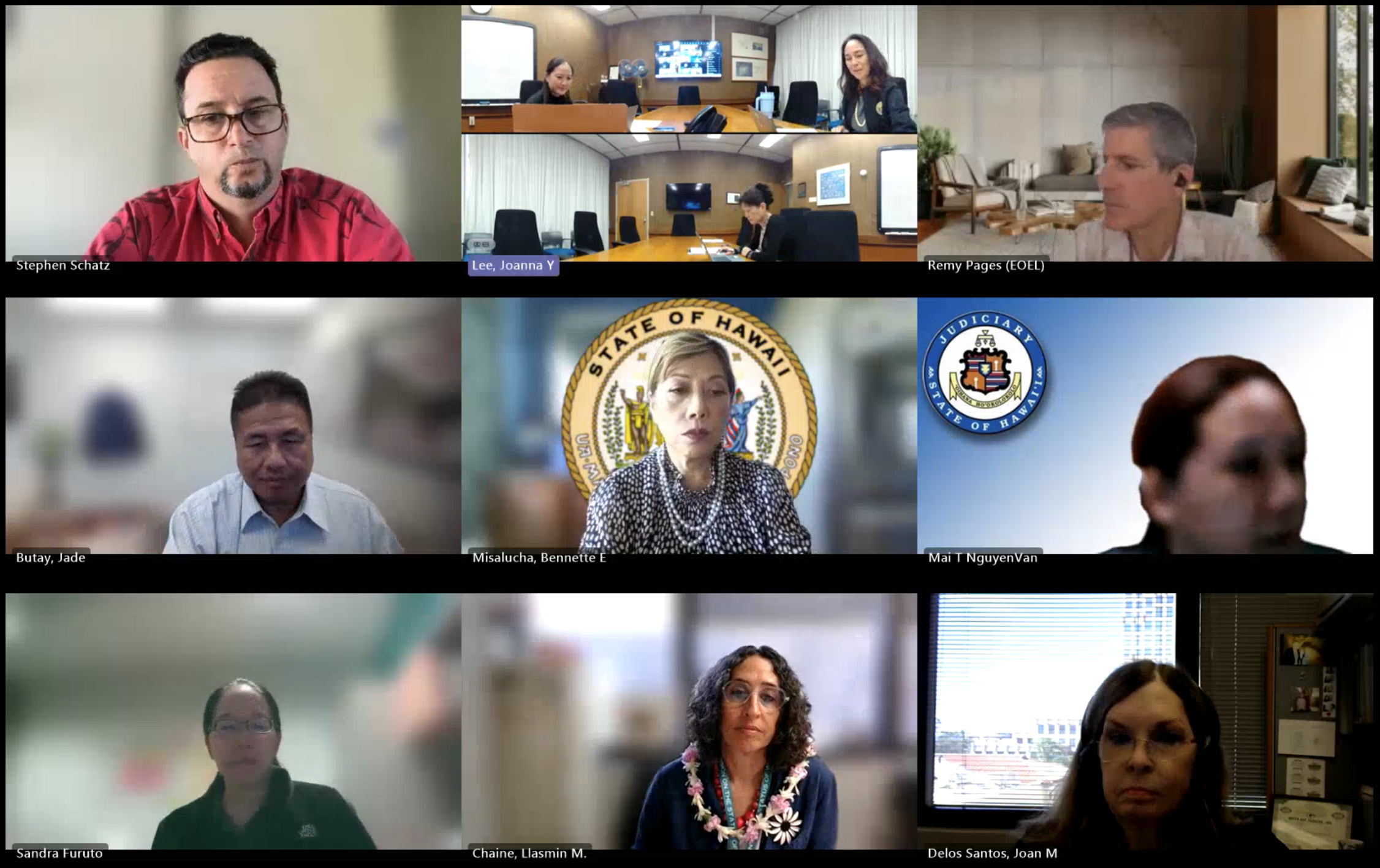
Thus far, the DSGWG has met twice, with a third meeting scheduled for early next month. As the working group performs this review process, it will develop recommendations for not only technology upgrades and modernization initiatives, but also for who will be responsible for data governance, and how it will be managed. Act 154 seeks to develop solutions for filling the gaps that currently make data sharing difficult by identifying a responsible agency; defining data-sharing protocols across state agencies as well as with private partners and the public at large; and developing a framework for future assessment, management, and improvement.
A priority of the working group is to identify a centralized coordinating agency to ensure effective cross-agency direction, collaboration, and accountability. The working group will present its answer to this question, as well as the others outlined above, ahead of the 2027 legislative session.
Why This Work Matters
To date, a recurring challenge interdepartmental and public-private partnerships have faced is the lack of a centralized lead agency or individual to manage data sharing aspects of projects. Well-intentioned policies designed to protect privacy often delay, complicate, or block data sharing because there are no policies or protocols in place to do so responsibly. Siloed and/or dated systems also can inhibit or add layers of complexity to data sharing. For example, in developing the First Five Hawaiʻi tool, Hawaiʻi Data Collaborative partnered with Hawai‘i Children’s Action Network to work with state agencies and programs to identify and map the agencies, data systems, and requirements across eighteen programs intended to support families with young children. This work was needed, in part, because standardized data sharing infrastructure and coordination protocols currently do not exist between state agencies.
A Shift Toward Strategic Data Governance
To our knowledge, the work of the DSGWG represents the state’s first official attempt to systematically evaluate and develop best practices around interdepartmental data governance and sharing. The diverse stakeholders on the working group as well as additional community members and organizations serving in advisory roles bring a range of perspectives and experience that will help to identify and address challenges and opportunities. This working group creates an opportunity to take a step back, assess the data landscape, and design an intentional approach.
This work signals a shift towards recognizing that data governance is not just a technical issue, but a strategic part of state policy, agency operations, and ultimately serving the people of Hawaiʻi. In developing recommendations for standards and best practices, it will be important to keep the goal in mind: to develop the infrastructure, policies, and protocols that will make broader data sets available and digestible to better inform workforce development programs and decisions.
Clearly defining ownership, accountability, and process makes data governance visible, and therefore actionable and fundable. If successful, these recommendations could lead to the establishment of state standards and infrastructure making cross-agency and public-private collaboration easier, more secure, and more impactful across all sectors.
--
The next meeting of Data Sharing and Governance Working Group will be on Wednesday, May 6, 2026 at 11am. Details can be found here.
--
A note on our role: Because Act 154 did not include funding for the Data Sharing and Governance Working Group, Hawaiʻi Data Collaborative has offered pro bono facilitation and information-gathering support to the group. We do not hold a seat on the working group.