
First Five Hawaiʻi: Behind the Development of a Tool to Help Families Find Support
In December 2025, the State of Hawaiʻi launched First Five Hawaiʻi, an online resource designed to help local families with children zero to five years old navigate eligibility for child care, housing support, nutrition support, parenting support, and more. Funded by the Preschool Development Grant (PDG B-5) awarded to the Department of Health, Department of Education, Department of Human Services, and the Executive Office of Early Learning, First Five Hawaiʻi represents a collaborative effort across government agencies and community to better serve families by making resources more accessible. This is a small yet significant step toward linking benefits program data in ways that reduce the burden on individuals and families seeking support.
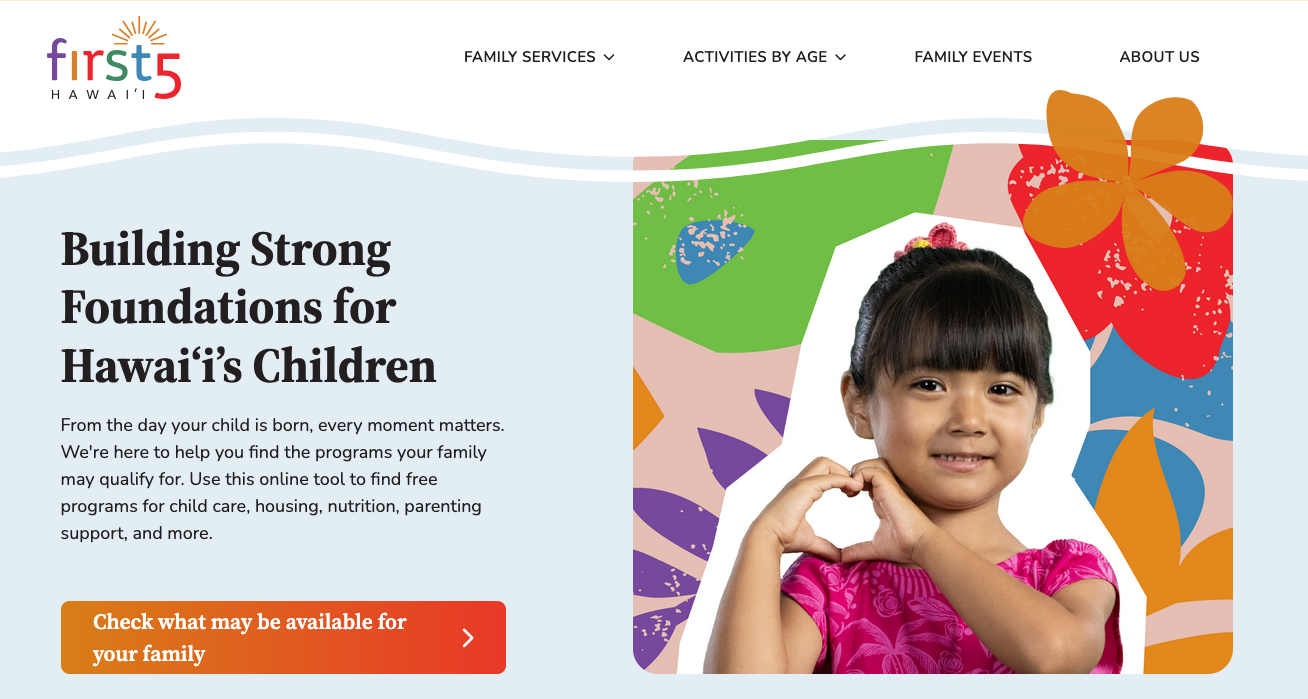
First Five Hawai‘i
When the state received the Preschool Development Grant, one of the core objectives was to increase access to support for families with young children. Programs like the Special Supplemental Nutrition Program for Women, Infants and Children (WIC), the Supplemental Nutrition Assistance Program (SNAP), Temporary Assistance for Needy Families (TANF), Preschool Open Doors, and Head Start can make a critical difference in the well-being of families and young children, but navigating access to these services can be daunting for families already working hard to make it through each day.
Investing in advertising wouldn’t get more families enrolled for benefits. Instead, the state recognized the need to address the largest barrier to families seeking assistance: figuring out which programs a family might be eligible for, and how to apply. First Five Hawai‘i is a tool that does just that. Based on similar tools implemented in other states including Nevada and South Carolina, First Five Hawaiʻi provides a single entry point to navigate services across agencies to simplify the application process.

Building Understanding First
When approached as a technical advisor on building the First Five Hawai‘i Eligibility Tool, we started by identifying the context that the tool would operate within: the stakeholders, users, existing systems, and intended outcomes. From our outreach, we identified two main needs for success: tapping institutional knowledge to understand the eligibility criteria across the eighteen programs that the tool covers, and addressing the needs and concerns of stakeholders to build support.
Building Institutional Knowledge
The eighteen programs the tool covers each have their own application processes and eligibility criteria, and are housed across multiple state agencies. Although there are overlapping criteria, each application is unique with specific adjustments and exceptions that vary from one program to the next. Mapping the nuances of these programs, including overlaps, dependencies, and variability in eligibility determination, was necessary to build a tool that balanced accuracy, sensitivity, and usability. Based on this eligibility analysis, the tool was built to have users complete one form, then receive recommendations for which programs they may be eligible for. Although the tool can’t guarantee eligibility, it points families in the right direction when it comes to applying for programs.
Building Support
Getting buy-in from program administrators across state agencies was key to the success of this project. Taking the time to not only listen to concerns, but to address them through clearly articulating what the tool would do and what it would not do helped gain the trust and support of the people who actually administer the programs First Five Hawaiʻi was designed to improve access to. One of the main concerns expressed by administrators was setting proper expectations with the public, so that families were not further confused about the process of applying to programs. Some of the complexities of determining certain program eligibility meant that the tool would not be 100% accurate. It was important to set clear expectations about what the tool is and is not designed to do: it helps households identify which programs they may be eligible for, but does not replace the process of applying to each program individually. To that end, we held multiple sessions with those in the community who would be working with families to clarify that this tool is a starting point to navigating program eligibility, not the final determinant.
Next Steps
First Five Hawaiʻi is a step towards improving access to programs designed for families with young children. Although the state has not announced plans to do so, a potential next step could be developing a common application for these sixteen programs. This would require collaboration across state agencies to work on data governance and standardization. This is precisely the kind of work the Data Sharing and Governance Working Group was established by the legislature last year to do — providing guidance and clarity for inter-departmental data use cases like this one. If a common application were successful, it would result in a greatly simplified and improved process for families seeking support. Ultimately, significant time investments and resources to take such a next step are still required, but the foundation for it – building relationships and mapping the eligibility criteria across the programs – has already been laid.
Correction: An earlier version of this article misstated the number of programs represented in First Five Hawai'i as sixteen; the correct number is eighteen.